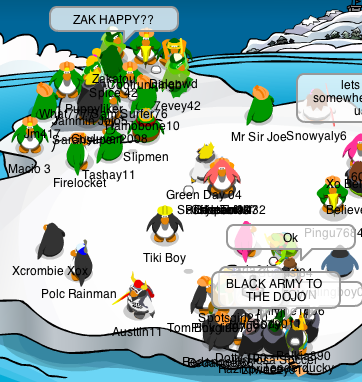
Rival armies terrorized bystanders when a playground war broke out in Club Penguin after school Thursday. Pink, blue and orange penguins fled as green and black armies exchanged snowballs and trash talk in a series of battles on the popular children's site... Somewhere in there is a worthwhile insight, and while I'm looking for it, you can enjoy these images from the scene.
 If you're the right age—and the
 little big boy in my house is right there—Club Penguin is a fun site that combines games and social features in a virtual world. Word on the playground is that CP has better games and inter-user interactions than WebKinz, though the plush WebKinz can be really cute, and the in-world accessories in WebKinz are more interesting. The Walt Disney Company (NYSE:DIS) liked Club Penguin, too, buying it last year for up to $700 million.
Part of what makes CP fun is the interaction among members via their penguin avatars. The entire experience is based in the virtual world, where kids can see and interact with other members. Many of the games are competitive (inner tube races down ski slopes, for example), and kids can type messages that are visible to others in the same area. (Site moderators watch to avoid the kinds of problems that make parents worry about their kids on the Internet.)
Oh, and they can throw snowballs any time they want. That part turns out to be relevant to today's events.
Virtual world, real social dynamics
In the course of some routine after-school research, my Junior Associate reported that CP wasn't fun today, because a bunch of kids had formed armies and were fighting a war. Usually, CP is populated with penguins of every color and accessory milling about, chatting (text) and playing games. Today, semi-organized groups of black and green penguins had a "war" (their term, not mine) that took over parts of the world. The usual, innocent chatter was mostly missing.
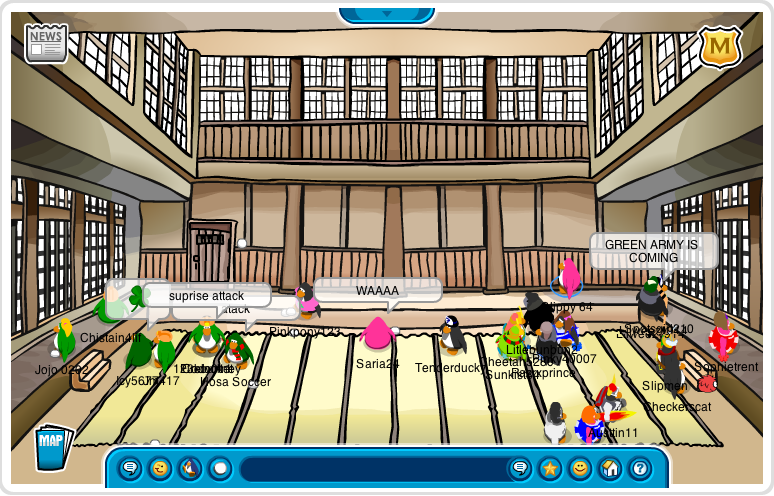 Everywhere Junior Associate went on the island, he found the war, and he didn't like it. He didn't like seeing all the snowballs being thrown, and he didn't like the trash talk. It was just like a real playground—the kids had self-organized around an activity that excluded some of the kids (possibly the younger kids?).
Of course, there are no real consequences when virtual snowballs are thrown. All that happens is that users see a lot of snowballs flying, but the kids know what those snowballs represent. My son's reaction wasn't too far from what you might expect from a real brawl. He reported some kids for bad language, and he wanted the "war" to stop. It's interesting that the virtual play-fight had virtually the same effect on him as a real one (yeah, I worked on that sentence).
So we had a fun little chat about online vs. real world, and then we had a little fun looking for a good picture of the action. Naturally, the big battle ended before I thought to grab an image, kind of like the perfect comeback line that pops into your head once the opportunity has passed.
Kids will be kids
Oh, wait, I promised some sort of insight, but all I'm coming up with is this: If you want to understand how people will interact online, first look at how they interact in the real world. True, online is different, and it's important to understand the differences. But human nature is the same. Group dynamics and behaviors from the real world shouldn't be a surprise when they show up online. Whether it's a play-fight in Club Penguin, in-crowd politics on Wikipedia or hateful gossip on Juicy Campus, you've seen it all before.



You don't know the half of it! I have studied Club Penguin wars, and they are one of the most popular Club Penguin pastimes. If you Type in "Club Penguin Army" on Google, you better be sitting down! There are over 400 armies, with reports that there are over 500, and new armies begin every day! There is even a website for all things CP war! there are "small", "medium", and "big" armies. They each have servers, which is like small pieces of land they own. They have "Recruiting missions". Some of the big armies are the Nachos, Army of Club Penguin, and Romans. they also have allies, flags, uniforms, and histories! Here is a link to CPA (Club Penguin Army Central) http://cpacentral.wordpress.com/ . as i said look up "Club Penguin Armies" on google.